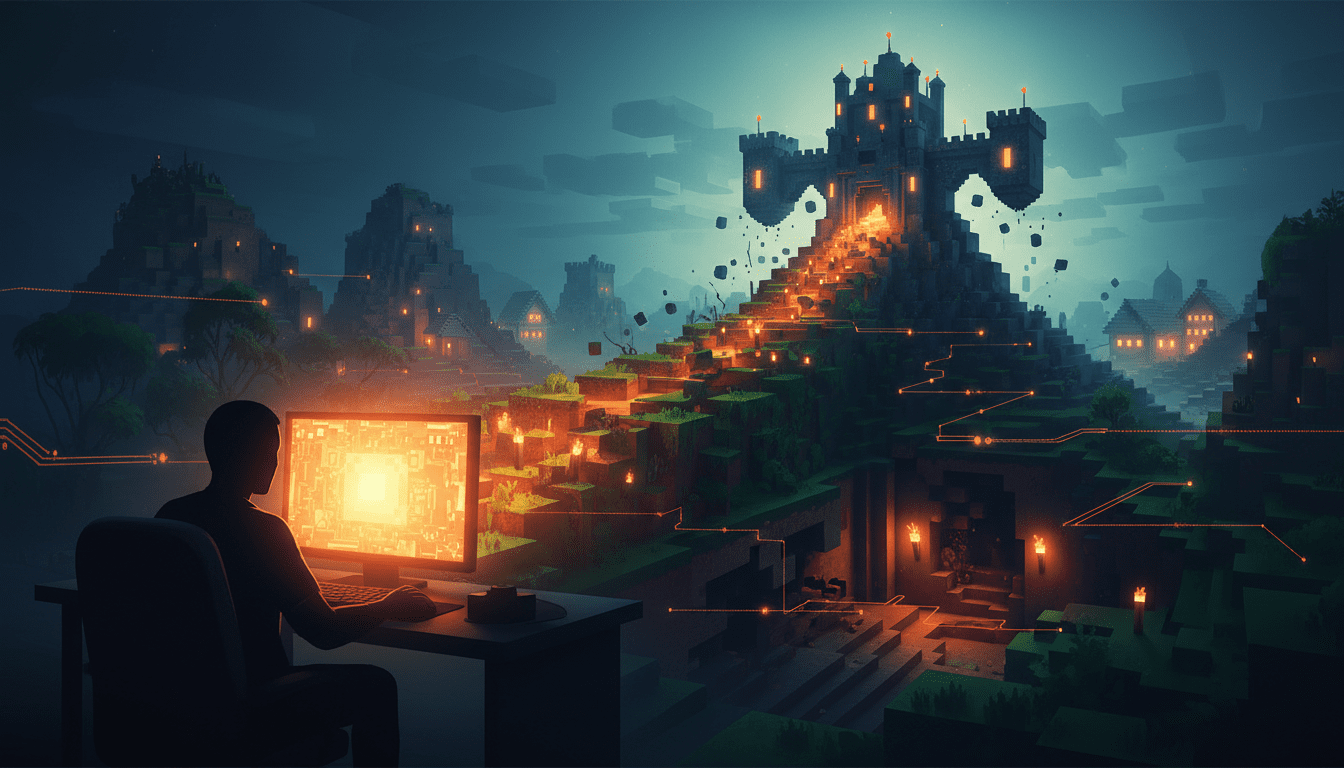
From Arcade Cabinets to Infinite Worlds
Video games didn’t become the world’s most influential entertainment medium overnight. They evolved in eras—each defined by a new kind of “wow.”
The early days were about simple mechanics and instant competition: Pong made play feel physical, Space Invaders made it feel urgent, and arcade culture turned games into public performance. Later, home consoles and PCs expanded what games could contain: longer stories, bigger worlds, deeper systems, and players who didn’t just chase high scores—they chased identity.
By the late 2000s, the industry had become blockbuster-heavy. Studios were spending Hollywood-level budgets, and “bigger” often meant “better.” Then an unlikely challenger appeared—not with cinematic cutscenes or famous actors, but with blocks, silence, and an idea so open-ended it sounded almost anti-commercial:
What if the point of a game wasn’t to win… but to build?
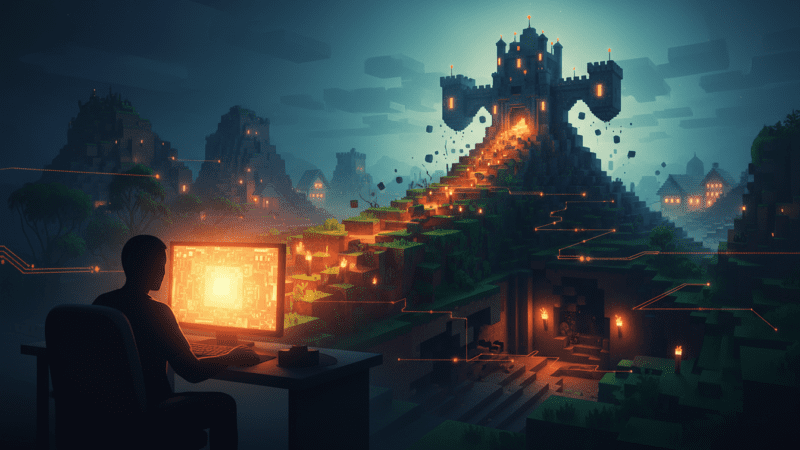
That idea became Minecraft, and it belongs squarely in Technology & Gadgets on PostsMix—not only because it’s software and a technical phenomenon, but because Minecraft is essentially a digital toolset disguised as a game: a world engine where creativity, logic, and community scale to infinity.
And the wildest part? It started as a one-man project.
“Minecraft is not about winning. It’s about having fun.” — Markus “Notch” Persson (often quoted in early interviews and community discussions)
Minecraft in One Sentence (and Why That Sentence Changed Everything)
Minecraft is a sandbox game where players gather resources, craft tools, survive (if they want), and build almost anything—alone or with others—in a procedurally generated world.
That sounds normal today—because Minecraft made it normal.
Before Minecraft, building was usually a feature inside another genre (strategy, simulation). Minecraft made building the main verb.
The One-Man Origin: Markus Persson and the Indie Spark
In 2009, Swedish developer Markus “Notch” Persson began experimenting with a block-based building game concept inspired by earlier creative and survival titles. But Minecraft wasn’t a clone—it was a remix that landed on something rare: a design so simple it looked unfinished… until you played it and realized you were the content.
The earliest versions spread online in the most powerful way possible: players demonstrated what the game allowed, not what the marketing promised.
Instead of trailers full of scripted moments, Minecraft grew through:
- screenshots of weird homes on cliffs
- time-lapse builds of massive castles
- underground cities lit by torchlight
- strange machines built from redstone logic
- survival stories: “I dug down and regretted it”
Minecraft didn’t just offer gameplay. It offered possibility.
Why Minecraft Felt Different (Even When It Looked Ugly)
Let’s be honest: at first glance, Minecraft looked like a rough prototype. The graphics were intentionally blocky and minimal. But that “limitation” turned into a superpower.
1) Low fidelity = high imagination
Just like LEGO, Minecraft’s simplicity invites your brain to fill in the gaps. A blocky wolf still feels like a pet. A square sunrise still feels beautiful. The world is “lightweight,” which makes your creativity “heavy.”
2) The world wasn’t designed—it was generated
Minecraft popularized procedural generation for mainstream players in a way that felt personal. Every seed felt like your world. Exploration became meaningful again.
3) Survival gave building emotional weight
In Creative Mode you build because you can. In Survival Mode you build because you must. That transforms architecture into storytelling: the first shelter you make isn’t pretty, but it’s unforgettable.
The Secret Sauce: A Game That Teaches Without Preaching
Minecraft is quietly educational—not in the “school software” way, but in the “you learned because you wanted to” way.
Players absorb:
- resource planning (don’t waste iron early)
- systems thinking (farms, mob spawns, villager mechanics)
- spatial reasoning (building at scale)
- basic logic (redstone circuits)
- project management (big builds require phases and materials)
A lot of games test skill. Minecraft grows skill.
“Give people tools, and they’ll surprise you with what they build.” — a common principle echoed by many game designers when discussing sandbox games
The Community Engine: Minecraft Became a Platform
Minecraft’s rise wasn’t just Notch’s design. It was what happened next: the community turned Minecraft into an ecosystem.
The YouTube effect
Minecraft was made for content before “content” was the center of gaming. Watching someone build a fortress or survive a hardcore world is inherently satisfying. Minecraft helped shape the creator economy in gaming—long-form series, server stories, roleplay, challenges.
Mods and custom servers
The game’s flexibility turned players into developers:
- new biomes
- new mobs
- automation systems
- RPG mechanics
- entire mini-games inside Minecraft
At a certain point, Minecraft stopped being “a game” and became “a place where games happen.”
Table: The Minecraft Growth Flywheel (Why It Kept Getting Bigger)
| Driver | What it did | Why it mattered |
|---|---|---|
| Simple visuals | Ran on modest PCs | More players globally |
| Sandbox freedom | No fixed “correct” way to play | Endless replay value |
| Survival + creativity | Emotional + expressive play | Broader audience |
| Multiplayer servers | Social gravity | People stayed longer |
| YouTube/streaming | Free marketing | Cultural domination |
| Mods + custom content | Community innovation | Expanded the game faster than studios could |
The Business Turning Point: From Indie Project to Global Deal
When Minecraft proved it wasn’t a trend, it became an asset the entire tech world understood: a platform with unstoppable network effects.
Eventually, Minecraft’s journey included a major acquisition that signaled something bigger than gaming: Minecraft was now a global digital infrastructure for creativity.
Even if you ignore the numbers, the meaning is clear: Minecraft had outgrown the label “indie hit.” It was now an institution.
How Minecraft “Rebuilt the Gaming World”
Minecraft didn’t just succeed—it changed what players expect from games.
1) It made “sandbox” mainstream
Open-ended play became a dominant design philosophy. Many modern games now include crafting, building, user creativity, or emergent systems because Minecraft proved that players love authorship.
2) It redefined what “graphics” need to do
The industry spent decades chasing realism. Minecraft reminded everyone that style and clarity can beat realism—especially when the player is the artist.
3) It normalized games as creative identity
Minecraft became part of how people introduce themselves:
- “I’m a builder.”
- “I’m a redstone engineer.”
- “I run a server.”
- “I make adventure maps.”
Those aren’t just playstyles—they’re roles, like in real communities.
4) It created a bridge between gaming and learning
Minecraft blurred the line between entertainment and education in a way that didn’t feel forced. That influence is now everywhere: coding platforms, STEM toys, creative apps, “learn by building” pedagogy.
Practical Takeaways (Yes, Minecraft Has Real-Life Lessons)
If you’re a reader who loves the story behind games, Minecraft is full of transferable lessons:
- Start small, ship early: Early Minecraft versions were rough, but playable. Feedback shaped the future.
- Design for users to create value: The player’s creations became the marketing.
- Community isn’t optional: Mods, servers, and creators weren’t side effects—they were the growth engine.
- Constraints can be style: Blocks weren’t a compromise; they became the identity.
FAQ
What inspired Minecraft originally?
Minecraft grew out of earlier ideas around block-based building, survival, and procedural worlds—then combined them into a loop that felt both simple and endlessly expandable.
Why did Minecraft become so popular compared to other indie games?
Because it wasn’t just a game—it was a toolkit. It supported creativity, social play, and content creation all at once, and it ran on modest hardware, making it accessible worldwide.
Is Minecraft still influential today?
Yes. Minecraft continues to shape game design trends (sandbox mechanics, crafting, survival loops), online communities (servers and creator culture), and education (learning through building and logic systems).
Conclusion: The Most Powerful Games Don’t Just Entertain—They Enable
Minecraft’s origin story is one of the clearest examples of a modern truth: sometimes the biggest revolutions don’t look revolutionary at first.
A lone developer. A blocky world. A few basic rules.
But those rules didn’t restrict players—they freed them. Minecraft didn’t tell people what to do. It gave them a world and said: make it yours.
And that’s how a one-man experiment didn’t just become a hit—it rebuilt what the gaming world could be.