Introduction
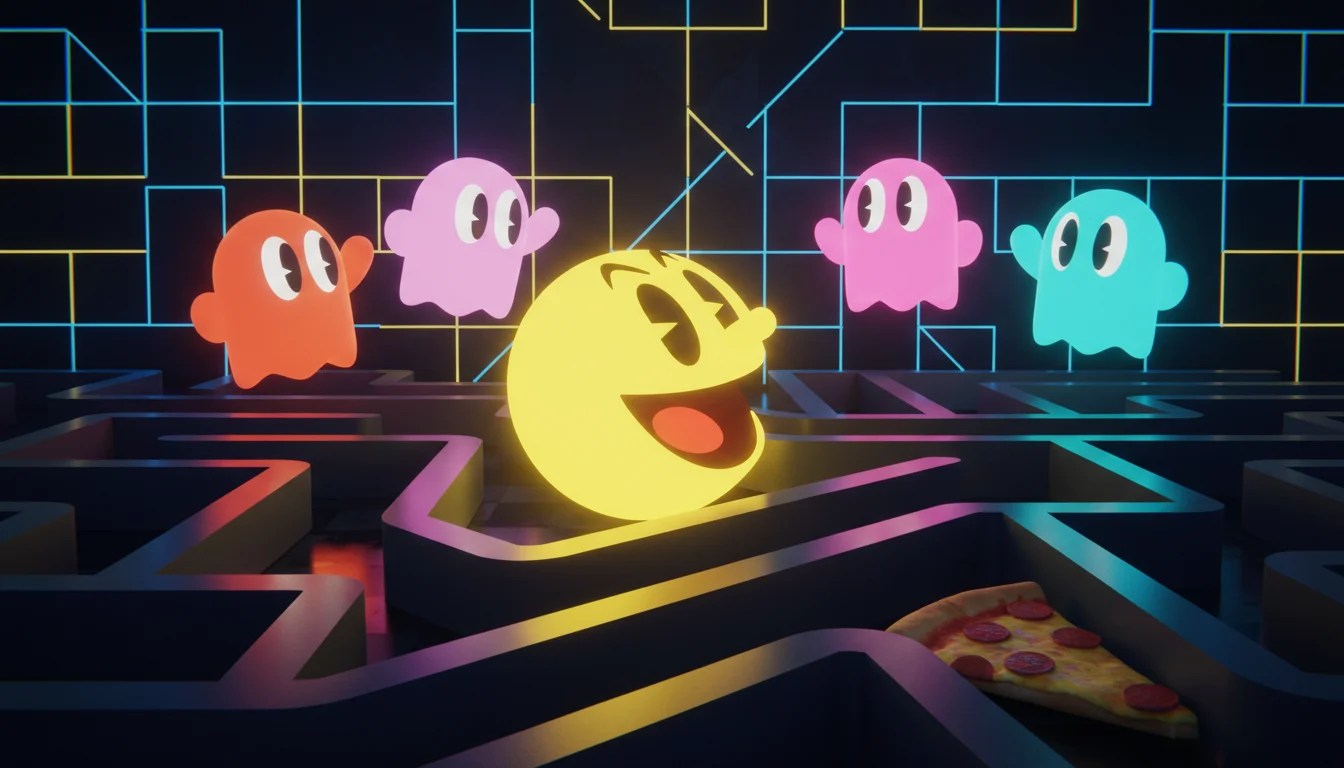
Before there were open-world adventures, battle royales, or photorealistic simulations, there was a small yellow circle — endlessly hungry, endlessly chased — eating dots in a maze. And somehow, that was enough to change the world.
Video games have a history as rich and layered as any art form. From the blinking pixels of Pong (1972) — the first commercially successful arcade game — to the reflex-driven chaos of Space Invaders (1978) and the block-stacking genius of Tetris (1984), each era of gaming has produced at least one title that transcended the screen and embedded itself into global culture. But few games have done so as completely, as joyfully, and as universally as Pac-Man.
Released in 1980 by Namco, Pac-Man didn’t just become a hit — it became a phenomenon. It was the first video game to appeal equally to men and women, to children and adults, to hardcore gamers and people who had never touched a joystick in their lives. It spawned sequels, cartoons, merchandise, a Billboard-charting pop song, and a cultural legacy that endures more than four decades later.
But where did it all begin? The answer, fittingly, starts with a pizza.
The World of Arcade Games Before Pac-Man
To understand why Pac-Man was revolutionary, you need to understand what gaming looked like before it arrived.
The late 1970s arcade scene was dominated almost entirely by shooting games. Space Invaders, Galaxian, Asteroids, Defender — the formula was simple: shoot or be shot. These games were thrilling, but they shared a common DNA: aggression, destruction, and a predominantly male audience.
Arcades themselves had a reputation problem. They were seen as dark, noisy, slightly dangerous spaces — not exactly welcoming to women, families, or casual players. The industry was booming financially, but it was also narrowing its own audience without realizing it.
That’s the world Toru Iwatani walked into when he sat down at a Tokyo restaurant in 1979 — and looked at a pizza.
The Pizza That Started It All
Toru Iwatani was a young game designer at Namco, a Japanese amusement company. Unlike many of his peers, Iwatani wasn’t obsessed with combat or destruction. He wanted to create something different — a game that women would enjoy, that couples could play together, and that felt warm and fun rather than aggressive.
One evening, the story goes, Iwatani was eating pizza with colleagues. He removed a slice — and stared at what remained: a round shape with a wedge missing. A mouth. A character.
“I was eating pizza when I had the idea of Pac-Man,” Iwatani later recalled. “I wanted to create a game that women could enjoy, something cute and fun.”
That simple visual spark became the foundation of one of the most recognizable characters in entertainment history. Iwatani and his small team of nine people spent approximately one year and five months developing the game, which was originally titled “Puck Man” in Japan — derived from the Japanese onomatopoeia “paku paku,” meaning the sound of a mouth opening and closing rapidly.
When the game was prepared for its North American release, the name was changed to Pac-Man — partly to prevent vandals from easily altering the “P” in “Puck” to an obscene letter on arcade cabinets.
How Pac-Man Works — and Why It’s Genius
The mechanics of Pac-Man are deceptively simple:
- Navigate a maze
- Eat all the dots (called Pac-Dots)
- Avoid four colored ghosts: Blinky (red), Pinky (pink), Inky (cyan), and Clyde (orange)
- Eat a Power Pellet to temporarily turn the ghosts blue and vulnerable — then eat them for bonus points
That’s it. No weapons. No shooting. No destruction. Just eating, running, and outsmarting.
But beneath this simplicity lies extraordinary design depth. Each ghost has its own unique AI behavior:
| Ghost | Nickname | Behavior |
|---|---|---|
| Blinky (Red) | Shadow | Directly chases Pac-Man |
| Pinky (Pink) | Speedy | Tries to get ahead of Pac-Man |
| Inky (Cyan) | Bashful | Unpredictable, uses Blinky’s position to calculate moves |
| Clyde (Orange) | Pokey | Chases when far, retreats when close |
This combination of ghost personalities creates a dynamic, ever-changing challenge that feels different every time — a hallmark of timeless game design.
As game designer Shigeru Miyamoto (creator of Mario) once noted: “Pac-Man proved that a game doesn’t need violence to be exciting. It just needs personality.”
The Launch and the Explosion
Pac-Man launched in Japan on May 22, 1980, and arrived in North America in October 1980. The response was unlike anything the gaming industry had seen.
Within one year, over 100,000 arcade cabinets had been sold in the United States alone — a record at the time. By 1982, Pac-Man was generating $1 billion per year in quarters. Adjusted for inflation, that’s roughly $3.2 billion today.
The game didn’t just attract gamers — it attracted everyone. Women, who had largely been ignored by the gaming industry, flocked to Pac-Man. Families played it together. Office workers snuck out at lunch to feed quarters into machines. Pac-Man had cracked the code that the entire industry had missed: inclusivity.
Pac-Man Goes Beyond the Arcade
What truly set Pac-Man apart from its contemporaries was its ability to leap off the screen and into everyday life.
Television: In 1982, Pac-Man: The Animated Series debuted on ABC, becoming the highest-rated Saturday morning cartoon of its premiere season, drawing over 20 million viewers.
Music: Also in 1982, “Pac-Man Fever” by Buckner & Garcia reached #9 on the Billboard Hot 100 — a pop song literally about playing a video game. It sold over 1 million copies.
Merchandise: Pac-Man’s image appeared on lunchboxes, T-shirts, breakfast cereals, board games, toys, and even bed sheets. By 1982, Pac-Man merchandise was generating an estimated $1 billion annually — separate from arcade revenue.
Home Gaming: The 1982 Atari 2600 port of Pac-Man became the best-selling Atari game of all time, with over 12 million copies sold — despite being widely criticized for its poor quality compared to the arcade original.
The Cultural Impact: More Than a Game
Pac-Man didn’t just entertain — it redefined what a video game character could be. Before Pac-Man, game protagonists were largely abstract (a spaceship, a paddle, a tank). Pac-Man was the first game character with a distinct personality, a name, and a recognizable face — paving the way for Mario, Sonic, Lara Croft, and every iconic game character that followed.
It also changed the demographics of gaming permanently. By proving that games could appeal to women and non-traditional players, Pac-Man helped build the foundation for the mainstream gaming industry we know today.
Cultural critic Steven L. Kent, author of The Ultimate History of Video Games, wrote: “Pac-Man was the first video game to become a true pop culture phenomenon. It didn’t just reach gamers — it reached America.”
Pac-Man also holds the distinction of being the first video game character to have a star on the Hollywood Walk of Fame — a testament to its enduring cultural status.
Pac-Man’s Legacy: Four Decades and Counting
The Pac-Man franchise has never truly stopped. Here’s a snapshot of its remarkable longevity:
| Milestone | Year | Detail |
|---|---|---|
| Original Arcade Release | 1980 | Japan launch; global phenomenon |
| Ms. Pac-Man | 1982 | One of the best-reviewed sequels in gaming history |
| Pac-Man Fever (song) | 1982 | Billboard Top 10 hit |
| Pac-Land | 1984 | First side-scrolling Pac-Man platformer |
| Pac-Man World | 1999 | 3D platformer for PlayStation |
| Pac-Man Championship Edition | 2007 | Critically acclaimed modern reimagining |
| Pac-Man 256 | 2015 | Mobile hit with over 10 million downloads |
| Pac-Man 99 | 2021 | Battle royale version for Nintendo Switch |
| Pac-Man’s 40th Anniversary | 2020 | Global celebrations, Google Doodle, new releases |
Today, the Pac-Man franchise has generated an estimated $14 billion in revenue across all platforms, merchandise, and media — making it one of the highest-grossing entertainment franchises in history.
What Pac-Man Teaches Us About Great Design
Beyond its commercial success, Pac-Man remains a masterclass in design principles that apply far beyond gaming:
- Simplicity is power. The rules fit in one sentence, yet the game is endlessly deep.
- Personality matters. Giving characters distinct traits — even the ghosts — creates emotional investment.
- Know your audience — then expand it. Iwatani deliberately designed for an underserved audience and captured everyone.
- Constraints breed creativity. A nine-person team, limited hardware, and a one-year timeline produced a timeless classic.
- Fun is universal. No language, no cultural barrier, no age limit — just joy.
FAQ
Q: Who invented Pac-Man and when?
Pac-Man was invented by Toru Iwatani, a game designer at Namco, and was released in Japan on May 22, 1980. The idea reportedly came to him while eating pizza — the missing slice inspired the character’s iconic shape.
Q: Why was Pac-Man so revolutionary for its time?
Pac-Man was the first major arcade game to deliberately target female players and non-gamers, breaking away from the male-dominated shooting game genre. It introduced a character with personality, non-violent gameplay, and universal appeal — changing the gaming industry’s demographics forever.
Q: Is Pac-Man still relevant today?
Absolutely. Pac-Man continues to release new titles, including Pac-Man 99 (2021) and various mobile versions. The franchise has generated over $14 billion in total revenue and remains one of the most recognized characters in global pop culture. Google has even featured Pac-Man as a playable Google Doodle, introducing it to entirely new generations.
Conclusion
From a half-eaten pizza in a Tokyo restaurant to the screens of over a billion players worldwide, the story of Pac-Man is one of the most remarkable origin stories in entertainment history. It is proof that the greatest ideas are often the simplest ones — and that a game doesn’t need guns, explosions, or complexity to change the world. It just needs heart.
Toru Iwatani set out to make something that would make people smile. He succeeded beyond any measure he could have imagined. And more than 45 years later, that little yellow circle is still eating dots, still outrunning ghosts, and still bringing joy to anyone willing to drop a coin — or tap a screen.
Some icons are born. Pac-Man was bitten into existence.